

Few stretches of airspace anywhere in Australia are as special to fly as the Sydney Harbour lane. Tracking down the Parramatta River, under the gaze of the city, past the Bridge and the Opera House with the whole harbour opening up beneath you — it’s the flight that makes passengers fall in love with helicopters, and it’s a genuine privilege to operate there. So when the procedures change, it’s worth understanding exactly what’s new and why.
Effective 26 November 2026, the way helicopters use the R407 Harbour Lane between Silverwater and Sydney Heads changes. Here’s the what, the why, and what it means whether you’re flying the lane yourself or sitting in the back enjoying the view.

What’s changing
Two things.
First, the altitude is going up and levelling out. The lane used to be flown as a stepped profile — not below 700FT from the rail bridge to Ryde Road Bridge, then 500FT between Ryde Road Bridge and the Harbour Bridge, then 1,000FT onward to Middle Head. From 26 November the whole transit runs at a uniform 1,000FT. The biggest practical change is that western segment over the Parramatta River, which rises from 500FT to 1,000FT.
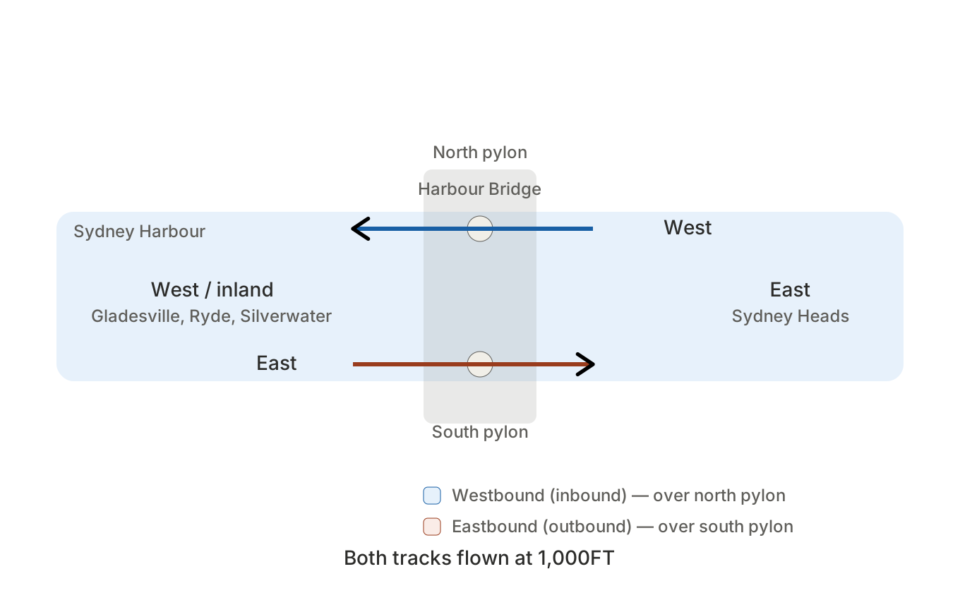
Second, there’s a new directional split at the Harbour Bridge. The lane is now described as two separate tracks rather than a single keep-right route, with opposing traffic laterally separated as it crosses the bridge line:
- Tracking east (outbound to Sydney Heads) passes over the southern pylon.
- Tracking west (inbound from the Heads) passes over the northern pylon.
So inbound and outbound helicopters are routed over opposite ends of the bridge rather than meeting over the same point. Simple, visual, and easy to brief.
Why it’s changing
This isn’t change for its own sake. The new procedure delivers four concrete improvements.
Traffic deconfliction at the Harbour Bridge. The Bridge is the natural pinch-point of the whole lane, and it’s where opposing traffic was most likely to converge. Sending eastbound over the southern pylon and westbound over the northern pylon builds in clear lateral separation at exactly the spot that needed it most, using landmarks every pilot can see from a long way out.
A uniform altitude along the lane. The old profile stepped from 700FT to 500FT to 1,000FT along the route. Flattening it to a single 1,000FT means less workload, fewer altitude changes to manage in a busy, high-lookout environment, and a more predictable picture for everyone sharing the airspace.
Reduced noise for residents. Along the Parramatta River west of the Harbour Bridge, the extra height means helicopters are operating further from the homes below. More altitude is one of the most effective noise-abatement tools there is, and this change puts meaningful distance between the lane and the communities underneath it.
Better forced-landing options. This is the one that matters most to us as operators and instructors. Altitude is time, and time is options. At 1,000FT rather than 500FT, a helicopter has more glide and more range in the event of an engine failure — which means more suitable areas within reach to carry out a safe forced landing or autorotation. If you’ve read our piece on what actually happens when a helicopter’s engine stops, you’ll know that every extra foot of height in the right place is a genuine safety margin, not just a number.
What it means for you
If you’re joining us for a scenic flight: nothing to worry about, and arguably a small win. The views are every bit as spectacular from 1,000FT — if anything you’ll see more of the harbour laid out at once — and you’re flying a procedure that’s now safer and kinder to the neighbourhoods below. It’s the same unforgettable trip, flown a little higher and a little smarter.
If you’re a pilot or a student: this is one to brief properly before you next operate the lane. New altitude, new pylon-based directional rule at the Bridge, and the usual high standard of lookout and radio discipline that R407 demands. Make sure you’re working from the current ERSA, check for any NOTAMs on the day, and if you’re training with us, your instructor will walk you through the updated procedure before you fly it.
The Sydney Harbour lane has always been one of the great flying experiences, and changes like this are what keep it that way — safer for pilots, quieter for residents, and still every bit as breathtaking.
Want to experience it for yourself? Take a look at our scenic flights, or if you’d like to be the one at the controls one day, come and talk to us about learning to fly.
This article is general information only and is not an operational document. Procedures, altitudes and effective dates are subject to change — pilots must always refer to the current ERSA, relevant charts and NOTAMs, and comply with ATC instructions.

